
















































The coaching carousel continues to get crazier each year, and the price tags certainly aren't getting cheaper. Imagine being the fifth winningest coach in the last four years, making it to a CFB semi-final a year ago, and now you're fired with a buyout of $50M - absolutely insane. The coaching carousel creates these lingering questions in my head about why athletic departments hire the way they do and why everyone keeps doing the same old thing.
These questions first came up for me in grad school while I was a graduate assistant for Auburn Football in player personnel. I had a class in my MBA program called Organizational Leadership, Ethics, and Change that explored how behavioral science can inform effective leadership and organizational design. I’ve always been drawn to questions of structure and process, and as I balanced grad school with working inside a major football program, the parallels between what I was studying and what I was living in daily became impossible to miss.
The Head Coach Position
For a second, let's think about the skills required to be a head coach in college football. If you spend 10-15 seconds on it, you'll most likely come up with similar skills such as: leadership, communication, vision, strategy, recruiting (relationship building), culture building, etc. These are pretty common and closely related to any executive or leadership position in life.
I look at some of these coaches across football who at some point in their career have been extremely good offensive or defensive play callers, but they may not have demonstrated the skills mentioned above to be head coach. But hey, they have been really successful on offense or defense, putting together a top five scoring team, and they get hired as the next head coach for a major program. Logically, I can see how athletic directors get there.
"If this coach can bring a top 5 offense/defense here, we'll win a lot of games!"
Sure sure sure. In theory, that's true. But, when you consider what happens to coaches' responsibilities when they move from a coordinator to a head coach, that logic falls apart pretty fast. Many coaches try and delay the reality when they assume the head coach title, but it's inevitable. It comes for them all: recruiting, roster management, transfer portal, media, managing donors and boosters, and more. These are demanding, time-consuming activities that take away from a coach's time watching film and trying to innovate how they scheme and game plan.
This is an unverified data point, but I think Jimbo Fisher is the only head coach plus primary play-caller to win a national championship in the last 25 years. There have definitely been coaches who won it all that were heavily involved in play-calling but no others who truly called it themselves and bore the responsibility day in and day out.
You Can't Do It All
Don't hear me wrong. There are success stories where an extremely talented coordinator was able rise through the ranks, shift into an "executive" head coach role, and immediately be successful, but I wouldn't go so far as to say it's commonplace. Those are the unicorns. More commonly, these coaches become the head coach with this mindset, "being a great play-caller and a coordinator is what got me here, so I need to continue to do the same". In fact, Texas head coach Steve Sarkisian said something almost identical this week when asked if he would consider giving up play-calling.
That's why I got hired. I was a really good offensive coordinator. I believe in what we're able to do. Every year, we have to continually evolve. There's going to be years where we're better on offense than we are on defense. There's going to be years when we're better on defense than we are on offense.
I'm a huge Steve Sarkisian fan. I have watched hours of his offensive teach-tape, and moreover I think he's a great play-caller, teacher, and leader. However, I do think he's reaching a critical point where giving up the offensive play-calling duties may be what's best for his team. Sark has a phenomenal offensive mind, and he's continued to re-invent his offense since the early 2000s. This move wouldn't necessarily mean that he can't utilize those skills in some capacity, but he could implement them differently. He could use them to identify an offensive guy who's doing things really well, who has the innovation and strategy that he sees in himself. He could leverage strategic concepts and decades of offensive adaption he possesses. Being the primary signal caller is a beautiful art. It requires a finger on the pulse of the shifting college football landscape - balancing your own tendencies with skill while exploiting the tendencies of the opposing coordinator, and it's hard to keep your finger on the pulse when you're spread so thin.
I sympathize with Sark. I sympathize with all the play-callers who fast track their way into college football stardom with their innovative scheme and ultimately find themselves in a battle between what they want to do versus what they should do. Technical entrepreneurs who build apps that go to tens of millions in revenue face the same dilemma. They love to code just like these coaches love to game plan and call plays, but they reach a point of diminishing returns where it's no longer the best thing for the business. The business requires an executive's touch now. It needs structure, process, culture, and strategic vision.
Delegation Breeds Success
Have you ever noticed when some of these play-calling coaches get hired, the opposite side of the football becomes the best part about their team within a few years? I think about how Gus Malzahn didn't even look at Auburn's defense. He let Will Muschamp and then Kevin Steele run their own show, never intervening in their operation, and the Auburn defense quietly became the team's identity from 2016-2020 while Auburn's offense continuously wavered. Coincidentally, Auburn and Hugh Freeze are in the same position today with DJ Durkin and the Auburn defense dominating. I can't help but wonder what this team would look like if Freeze had let Phillip Montgomery or another offensive coordinator run their own show from the beginning. The seat might not be so hot right now, and in fact, Auburn may very well have been an SEC contender this year. Reverting back to Texas, Pete Kwiatkowski has the Texas defense performing at a top five clip yet again in 2025, while offensive guru Steve Sarkisian and his offense struggle for the second year in a row.
I think Nick Saban and Bill Belichick figured this out early on. I remember watching their documentary when Saban was the defensive coordinator for the Belichick-led Cleveland Browns, and Belichick tried to butt in on schemes and game planning in the middle of a game. Saban firmly said something like, "Bill! We got it!", letting Belichick know he had it under control and to let him do his job.
I watched how Saban operated for years at Alabama, going through coordinator after coordinator on the defensive side of the ball yet continually putting out top five defenses. As a personnel guy, I realize good players helped their performance a lot, but Saban always delegated play-calling duties. And now Kirby Smart, Dan Lanning, Mario Cristobal, and even offensive genius Lane Kiffin have adopted the same methodology as they have become head coaches, delegating play-calling to assistants even though they themselves probably have the best strategic mind on the team. I promise you they aren't giving up play-calling because it's their desire; they realize it's the best path if they want to win. Conversely, Billy Napier insisted on being the play-caller, and now he's out at Florida.
Being Strategic and Innovative is Hard
It's important to note that being on the cutting-edge in terms of offense and defense is really difficult. Coaches are constantly trying to re-invent their scheme to gain an advantage and be less predictable. Offenses innovate constantly, such as the emergence of the spread, then the RPO, always finding new avenues for creating conflict for defenders. Therefore, defensive guys spend all offseason trying to determine how they can tweak their coverage to take away new schemes of the offense.
Last week I was watching a video where Kirby Smart was teaching the foundations of Georgia's defense, specifically how they have had to change to defend a more "pass-first" approach to offense in the new era. Alabama's 2018 offense and the national championship matchup was a big motivator, causing them to look inwardly about their scheme. While Smart and Georgia's primary focus is still run defense, they are redefining what it means to be a good run defense. This was the bolded quote on one of Kirby's slides.
The better you are at stopping the RUN, the more guys you can commit to stopping the PASS.
Fundamentally, Kirby is striving to determine the minimum amount of defenders they can commit to the run so that they can defend the pass better. They have re-worked their entire defensive fronts and run fits to try and stop the run without committing an extra hat to the box.
These are the types of concepts that coordinators should spend all offseason addressing and problem solving. Having said that, head coaches who are good with X's and O's shouldn't be removed completely (if they so desire). As I mentioned with Sark, he has decades of experience problem solving on offense. Kirby Smart and Lane Kiffin are the same way. They have seen so much ball, and it's their job to poke holes in the architecture proposed by the coordinators. It's their job to use their experience to equip, enable, and empower their coordinators to be better.
The "Triad" Model: A Modern Approach to Football Leadership
Alright, back to the problem at hand. Put your behavioral science hat on with me for a second. What's so great about being the head coach? Is it the money, the ego, the power of being the head man who gets to call the shots? I'm sure it's a combination of all three and more. A big part of this discussion hinges on those intrinsic motivations, which I can't fully measure, but they're worth acknowledging.
Now, imagine a world where a school like Texas A&M doesn’t have to offer Jimbo Fisher $100 million and, in doing so, expose their boosters and university to enormous financial risk. If your school’s pockets are endlessly deep, great. But for most programs, especially in the new NIL era, that kind of spending spree just isn’t sustainable.
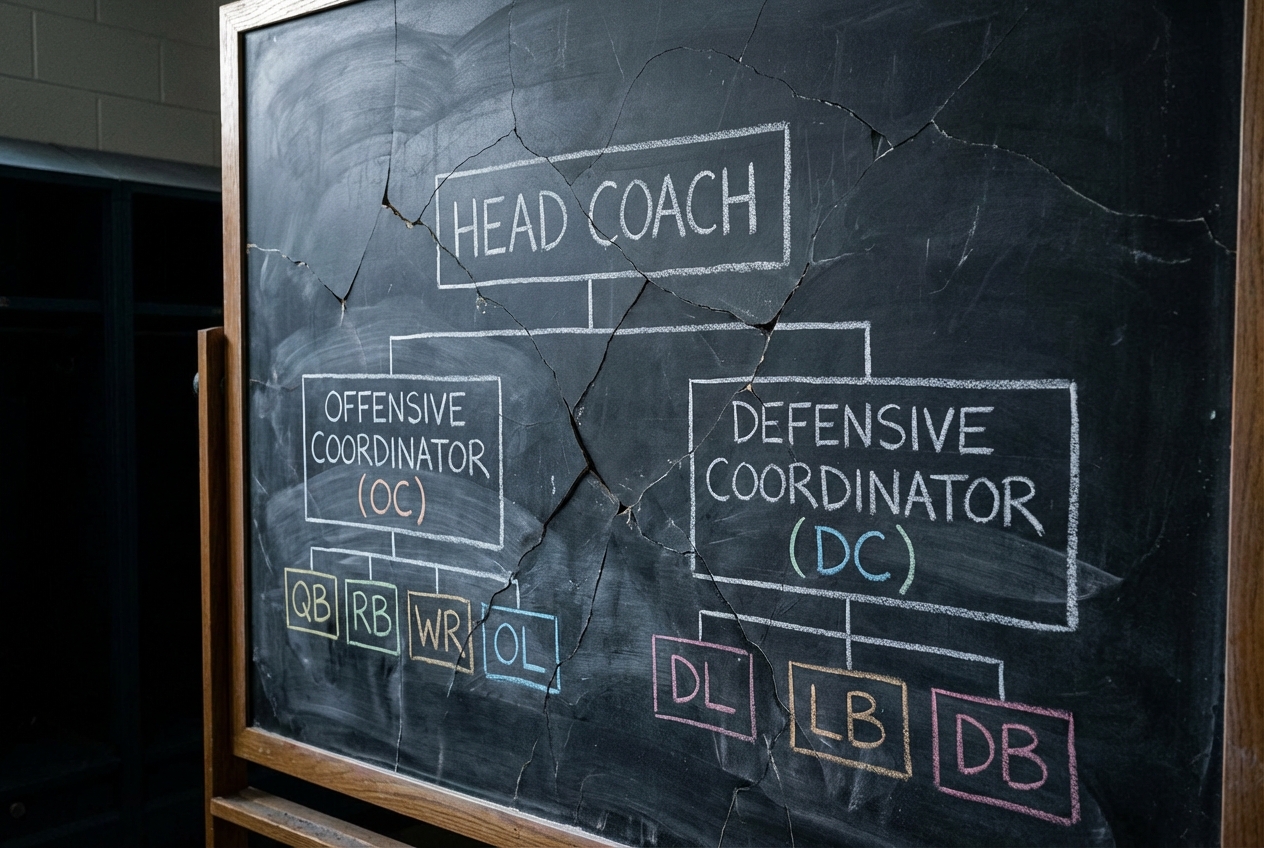
That’s where I’d like to introduce a less risky, more modern model of leadership and program structure. The name’s still a work in progress, but let’s call it the “Triad” approach.
Here’s the problem: at major programs today, the head coach earns around $10 million, while the offensive and defensive coordinators earn $2–3 million. This setup makes it almost impossible to properly reward the real innovators, the elite signal-callers and tacticians, without giving them the head coaching title.
I think that’s nonsense. And it doesn’t have to be this way.
If you’ve been in football your entire life, you’ve probably never worked in a structure where a subordinate earns more than their superior. But in the corporate world, that’s completely normal. Take sales, for instance: high-performing salespeople are compensated through commissions, and it’s common for them to earn far more than their sales managers. The system rewards performance and value creation, not title or hierarchy. Exceptional engineers at major tech companies have a similar structure. They are world-class at what they do, and they should be compensated fairly.
I think it's perfectly reasonable to hire an executive-style head coach who sits above the offensive and defensive coordinators in organizational hierarchy; however, their compensation doesn't need to be two or three times higher. We can reward world-class signal callers to do their jobs exceptionally well while hiring a head coach whose greatest strengths are leadership, roster management, culture, and building great processes.
A Good Example and a Cautionary Tale
The closest example to a triad approach I've seen in the last decade was Dabo Swinney's Clemson during the Brent Venables era. Dabo knew Venables was an elite defensive mind in college football, and he managed to keep Venables at Clemson for ten years! That's an eternity in college football for coordinators. When Venables left for Oklahoma, he spoke about how hard it was to walk away (sourced from Clemson radio station WCCP The Roar):
"I woke up every day in a place I loved living, just absolutely loved living... Then I went to a job that my cup runneth over every single day. And well beyond just the football, the Xs and Os. I just loved who I was doing it with, and certainly, the players are a big part of that. But our staff and the vision of coach Swinney, he just brings out the best in everybody, in my opinion. And so, really, my experience there really enriched my life forever."
I know Dabo can come across a bit corny or cheesy in the media, but I've heard this same sentiment from friends in the industry who have worked at Clemson - they love it. Dabo has had an unbelievable run there because he established a great culture, hired good folks, and let them do their job. That's what the executive head coach should be doing.
What's ironic is that Brent Venables has now found himself the villain in this story (only jokingly). He fired his defensive coordinator after last year and has assumed play-calling duties in 2025. And guess what, Oklahoma's defense is fantastic, and he's doing a great job calling plays. My point isn't to say that model can't work for a short time. It can work. It does, however, become really difficult to sustain as your head coaching tenure spans longer.
Experimentation is a Risk
It's certainly understandable why athletic directors haven't taken significant "risks" like altering the coaching structure. If it doesn't work out, you look like an idiot who strayed from the norm. You know what else is idiotic and a major risk? Paying coaches $100M in guaranteed money, and then paying them $70M and $50M to sit on the couch once you fire them.
You'd think though, that in an era of hundreds of millions of dollars in payouts, someone will try to innovate with structure. SOMEONE will take a risk and try to do things a bit differently.
It only takes one domino to fall - one visionary, one organization - like Billy Beane and Paul DePodesta with Moneyball in Oakland. After that, every other team in the league starts tearing down its roster to rebuild it just like yours.
Please login to make comments.